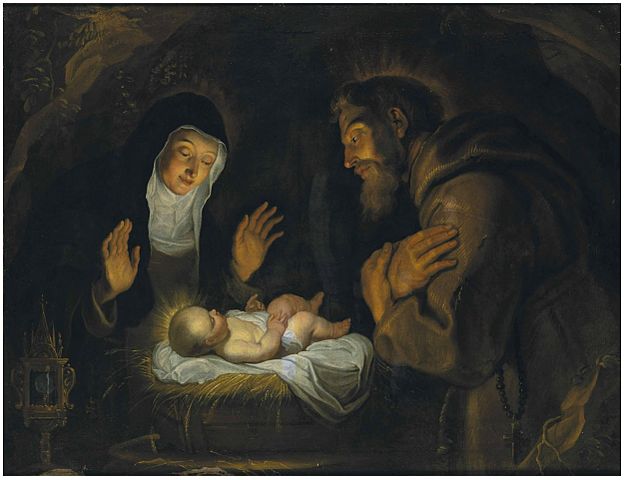
 St. Francis and St. Clare
by Theresa Cavicchio, OFS
The October 4th feast day of Saint Francis of Assisi (1182 – 1226 A.D.) offers an opportunity to reflect on some of those who supported him in his ministry. While numerous male followers flocked to join Francis’ Friars Minor, here we will consider some of the holy women who played significant roles in his story.
~ Lady Pica ~ The woman who brought Saint Francis into the world is said to have been of noble French parentage. Married to the prosperous merchant Pietro de Bernardone, Lady Pica enjoyed a comfortable lifestyle and high standing in the Assisi community. Tradition portrays her as a loving mother whose devout Catholic faith influenced Francis, for example, in kindness toward the poor from his youth.
One incident in particular demonstrates Lady Pica’s maternal devotion. In the springtime of Francis’ conversion, having spurned his pleasure-seeking ways in favor of a deepening relationship with his Savior, Francis sold bales of his father’s stock of cloth and also sold his horse. The proceeds were intended for repair of the abandoned Church of San Damiano.Hearing of this, and witnessing townspeople’s taunts toward Francis, Pietro became so enraged that he chained his son in the cellar of their home. After several days, while Pietro was away, Lady Pica seized the opportunity to speak with her son, seeking to understand his heart. Convinced of his resolve to convert his privileged life to one of poverty and penance, she braved her husband’s anger and released Francis, freeing him to continue on his journey to Christ.
~ Lady Poverty ~ Saint Francis often is referred to as the “Poverello,” the “Little Poor Man.” From its very inception, the Franciscan Order had poverty as its foundation. On this one matter, Francis was adamant. He and his Friars Minor were to own nothing, thus freeing themselves as totally empty, open to the Lord Jesus and to the proclamation of His Gospel. Francis’ pursuit of the figurative “Lady Poverty” can be equated to that of a young man for the woman who would capture his heart.
The Sacrum Commercium (Sacred Exchange) is a medieval allegory chronicling the hypothetical search of Francis and his friars for Lady Poverty. Reflecting on this work, Murray Bodo, OFM, writes that Francis and his brothers “lived their walking in the footsteps of Christ: not gritting their teeth in grim determination, but traveling joyfully, inspired by Lady Poverty, the Mystical Bride of Christ, the only one to ascend the Cross with Jesus.” Poverty, simplicity, and joy were hallmarks of Franciscan spirituality from the outset.
~ Lady Clare ~ Clare Offreduccio – beautiful, intelligent, and pious – was the eldest daughter of a noble Assisi family. As such, she was presumably destined to marry well, enhancing the family’s prestige. Her conviction that her heavenly Father had a different plan for her life was confirmed when she heard Francis’ impassioned preaching. His stirring words spoke directly to her heart. Chaperoned secret meetings between them convinced her that, like Francis, what she truly desired was a life of poverty and chastity, totally founded on Jesus and His Gospel.
On the night of Palm Sunday, 1212 A. D., the teenaged Clare stole from her family’s home. She fled to the Portiuncula, the small chapel where Francis’ Order had begun. Francis cut her beautiful hair and gave her a rough tunic in place of her fine garments; Clare reveled in the spiritual freedom she experienced on that solemn night.
Clare and a group of like-minded women – including her own mother and two sisters – engaged in a life of strict poverty and constant prayer at San Damiano, near the church which Francis had repaired after hearing Jesus’ voice there. Only two years after her death, Clare was canonized a saint. Her Order of women religious, the Franciscan Second Order, was initially termed the Poor Ladies, and is known today as the Poor Clares.
~ Lady Jacopa ~ In his biography of Saint Francis, Omer Englebert recounts the unique friendship between Francis and Lady Jacopa de Settesoli, a wealthy widow who hosted him and his friars when in Rome. She became what Englebert terms Francis’ “great and faithful friend … an able woman, well deserving because of her virile energy, the name of ‘Brother Jacopa’ by which Francis made her famous in history.”
Apparently, Jacopa was also an excellent cook. Setting aside his customary abstemious eating habits, Francis succumbed to her sweet almond confections called mostaccioli. As the end of his earthly life approached, Francis dictated word to “Brother Jacopa,” asking that she bring articles necessary for his burial. “And please bring with you some of the good things you gave me to eat when I was ill in Rome.”
Just as the appointed messenger was about to set out for Rome, Lady Jacopa arrived, having been inspired in prayer to leave for Assisi immediately. She came prepared with burial cloths, candles – and yes, mostaccioli – and was privileged to help prepare his body for burial.
~ Our Lady ~ Saint Bonaventure writes of “the exceeding love which [Francis] bore to the Mother of Christ.” This sentiment is echoed in numerous Franciscan sources. The reality of the Incarnation – God the Father sending His only Son to earth – was a constant source of wonder and spiritual joy to Francis. Our Lady, the vessel chosen by the Father to enflesh this reality, was incredibly dear to Francis.
It is fitting for us to conclude our reflection with Francis’ own words of praise for the holiest of all women – the Immaculate Virgin so close to his heart. In honor of Francis’ feast, may we bring these sentiments to prayer today.
A Salutation of the Blessed Virgin Mary
Hail, O Lady, Holy Queen, Mary, holy Mother of God, Who are the Virgin made Church, chosen by the most Holy Father in heaven whom he consecrated with His most holy beloved Son and with the Holy Spirit the Paraclete, in whom there was and is all fullness of grace and every good.
Hail His Palace! Hail His Tabernacle! Hail His Dwelling! Hail His Robe! Hail His Servant! Hail His Mother!
And hail all You holy virtues which are poured into the hearts of the faithful through the grace and enlightenment of the Holy Spirit, that from being unbelievers, You may make them faithful to God.