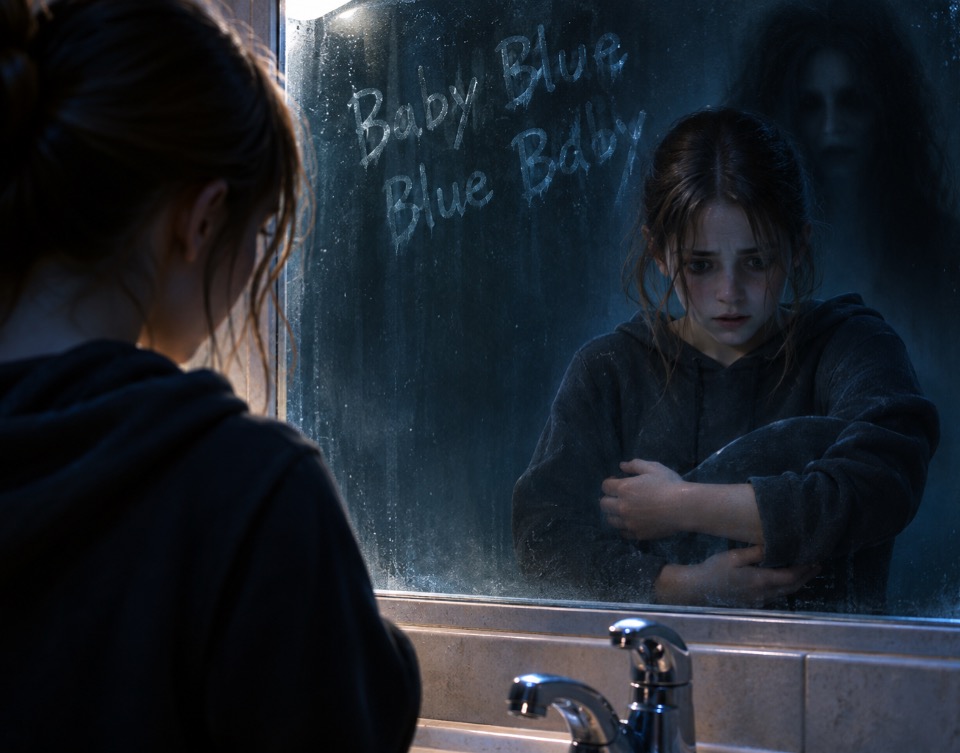
 A Catholic school teacher expressed concern to us about a sleepover game known as the Baby Blue, Baby Blue game and popularized by TikTok in which children hide in a bathroom and invoke the spirit of a dead baby. Should parents be concerned about this game?
Hideandgokillwiki, a site hosted by Fandom that catalogs paranormal legends, creepy pasta rituals and scary internet games, describes how to play Baby Blue, Baby Blue:
“Begin at night, now, enter the bathroom, then, once inside, lock the door. Once the door is locked, face the mirror, position your arms as if you're cradling a baby. Now, gently rock your arms back and forth and chant, ‘Blue baby, baby blue,’ while rocking your arms. . .”
This chant is to be repeated 13 times, during which time the person may begin to feel weight in their arms.
“Do not falter, do not panic, stay alert,” the site encourages. “This weight may begin to feel and grow heavier, when this happens, stay alert. You will start to feel scratching on your arms, do not falter, it's time.”
When the scratching is felt, the person must quickly drop the weight into the toilet and flush it, then exit the bathroom as quickly as possible.
“Failure to complete all of these actions and follow the rules of the game will result in one of two situations,” the site continues. “A woman may appear in the mirror, demanding the return of her baby. Or, the scratching on your arms will become unbearable.”
Some sites warn that the woman may scream “Give me back my baby” so loudly it will shatter the mirror. Others say the woman could hurt the person summoning the child.
From what I have been able to find, the Baby Blue game is a supernaturally-themed children’s game that appears to be an offshoot of the much older Bloody Mary legend which also involves summoning a spirit before a mirror in a dark room. Although the precise origins of the Baby Blue game is unknown, folklore research provides some interesting clues about how it developed over the years since Bloody Mary appeared in the 1970s.
In the book by folklorist Janet Langois, Mary Whales, I Believe in You, some versions of the Bloody Mary game involved children accusing the apparition of losing or killing a baby, and of some players saying they killed a baby themselves during this game. These details have sparked a theory suggesting a possible connection to what would later evolve into the Baby Blue game.
A game by the name Baby Blue, Baby Blue first appeared on a website known as Scary for Kids as early as 2010 although it did not originate there. At the time, it was already an existing urban legend.
It continued to spread through social media until it began to trend as a TikTok challenge around 2023 with participants filming themselves attempting the supposed summoning ritual.
At this point, some schools even issued warnings to parents about children encountering or attempting the game.
Some parents have also raised objections to the game’s imagery of flushing a child down the toilet as desensitizing children to infanticide, abortion, and even parenthood in general.
What I could not substantiate in the origins of the game is any connection to the occult, such as to witchcraft, ceremonial magic, or any other identifiable occult tradition. However, this doesn’t mean we can overlook the fact that the central activity of the game is an imitation of spirit summoning. This is concerning because although most children report viewing the game as just another form of scary entertainment, others say they had a supernatural encounter while playing the game.
In this study, British schoolchildren in 2018 discuss both the Baby Blue and Bloody Mary game and provide evidence that they were treating it as a supernatural summoning game. While there’s a big difference between children pretending to summon a ghost as part of a scary game and someone seriously attempting to invoke a spirit, Catholic parents and educators need to be aware of how fine a line can be drawn between these two possibilities.
Even if a child starts out playing the game just for fun, repeated exposure to simulated spirit-summoning activities could make such practices appear worth experimenting with. Especially if the child already believes in ghosts, the game might reinforce the idea that supernatural entities can be contacted by following certain instructions.
Although I did not find any evidence of this happening in relation to the Baby Blue game, local churches have issued warnings about similar games, such as the Charlie Charlie game that was trending in 2015 that can be applied to the Baby Blue game as well.
In this article, appearing in the Boston Pilot, Father Matt Williams, director of the Faith Formation of Youth and Young Adults, was giving advice to parents whose children were caught up in the Charlie Charlie game, another supernatural sleepover game which involved summoning the spirit of a dead child name Charlie and asking it questions.
"Even if this is a gimmick, you're teaching kids. You're welcoming kids down the road or showing them down the path of divination, and you're planting seeds for the future, which is not a good thing at all. Or, you're going to open up the curiosity for them to start looking into the occult in other kinds of ways, which could find themselves getting into trouble down the road," Father Williams said.
In conclusion, the danger of the Baby Blue Game is that children are being encouraged to pretend they can summon the dead—and some are beginning to believe it. What starts as a scary game can blur the line between harmless make-believe and a genuine desire to experiment with the spirit world.
© All Rights Reserved, Living His Life Abundantly®/Women of Grace® http://www.womenofgrace.com
Send your New Age questions to newage@womenofgrace.com
