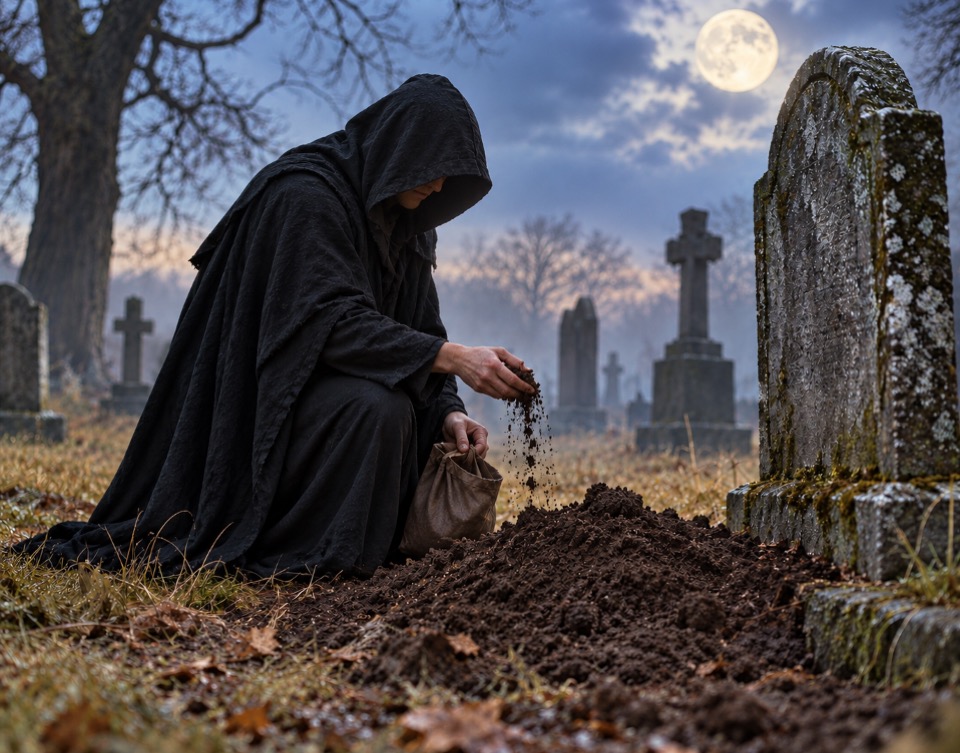
 A recent discussion about graveyard magic on Wacky Wednesday led to a further exploration of one of its filthier practices – the use of graveyard dirt. Is this really a thing?
Yes! In fact, it’s quite common for witches, sorcerers, and other practitioners of folk magic to seek dirt from graves to work their magic.
As this article explains, “Grave dirt is a physical object that some believe possesses the traits of the person it was used to bury.” Practitioners of folk magic believe there is a magical connection between the dirt and the deceased person buried beneath. For example, a person might gather dirt from the grave of someone they love to use in love magic, or scoop some dirt from the grave of a convicted murderer to use in curses. Dirt taken from graves of those who died violently or "before their time" is used in more aggressive spells, coercive magic, or returning harm to an enemy.
The use of soil from a graveyard is believed to date back to the ancient Egyptians who may have used it along with bones from funeral sites for magical practices aimed at cursing or conjuring the dead.
The use of graveyard dirt for magical purposes is also associated with African American folk magic and was very prevalent during the era of the slave trade.
As this article explains, the Bakongo people of Central Africa believed dirt from a grave contained the spirit of the person buried in it and considered it to be a powerful ingredient in magic. They brought these beliefs with them in the 1730s when they were brought to the American colonies as slaves in the 1730s.
“These people, known as Bakongo (for Bantu-Kongo) or Kongo, were mostly used as field hands....Although enslaved Africans were forbidden from practicing their religions or ritual magic, some of their beliefs survived as ‘folklore’ or ‘superstition.’ The use of graveyard dirt to curse someone is one example.”
 They believed that different spirits have different energies so one must choose the grave carefully depending upon the desired spell. But one does not just walk into a cemetery and grab some dirt. In order to be effective, it should be someone known to the collector, preferably a family member, or someone who was at least known to them and may have impacted their life in a positive way. For example, dirt from a wealthy man’s grave could be incorporated into a spell for prosperity. Dirt from the grave of a writer or artist could be used for a conjuring of creativity.
In addition, the dirt couldn't just be taken - it had to be “bought” which involved communicating with the spirit of the deceased and respectfully asking permission to use the dirt. A payment of some sort had to be left behind, such as money or liquor.
“Only take a small amount of dirt—no more than a handful. Finally, be sure to say thank you when you're finished.”
As Jesus C. Villa explains in his thesis, “African Healing in Mexican Curanderismo,” there is documented history of graveyard dirt being used by slaves to prevent them from being harmed by their masters. “In 1650 CE, another enslaved African named Mariana was accused of serving her slave owners 'powders of roasted bats and grave dirt in order to tie them, or prevent them from mistreating her.'"
While it’s never used in potions meant for drinking (for obvious reasons), it’s typically put into mojo bags, pouches, or amulets. A tiny pinch of the soil will be placed inside a flannel mojo bag along with herbs, roots or personal items like a strand of hair. Dirt from a loved one’s grave might be kept in a protective amulet.
In Hoodoo, the dirt is frequently sprinkled where a target is expected to walk. For example, graveyard dirt known as “hot foot powder” is used to drive away an unwanted person by sprinkling it on a doorstep or path where the target usually walks.
Graveyard dirt is the primary ingredient in goofer dust, a traditional magical powder mixed with sulfur, salt, herbs, powdered snakeskin, charred bones, dead bugs and other ingredients and is used for crossing, jinxing, or driving off enemies. The word “goofer” comes from the Bantu and Kikongo words Kufua or kufa, which means “to die.” This dust is used to jinx or drive off enemies by placing it wherever the person might step such as a doorstep, yard, or pathway. It’s also placed under or around a target’s bed or hidden in their clothing. It’s used in spell work to dress candles, stuff voodoo dolls or sealed inside mojo bags.
A dish of graveyard dirt is frequently kept on an ancestral altar in a private home where it is believed to serve as a literal “phone line” to keep the portal open between a living practitioner and their dead ancestor.
Needless to say, the Church does not condone sorcery of any kind, including that which involves dirt from the graves of the deceased.
As the Congregation for the Doctrine of the Faith instructed in Ad resurgendum cum Christo (Instruction regarding the burying of the deceased and the conservation of the ashes in the case of cremation) the bodies and graves of the dead are to be treated with great reverence.
“…[B]urial in a cemetery or another sacred place adequately corresponds to the piety and respect owed to the bodies of the faithful departed who through Baptism have become temples of the Holy Spirit and in which ‘as instruments and vessels the Spirit has carried out so many good works’.” (No. 10)
Yes, graveyard dirt is a thing - and one we should strictly avoid!
© All Rights Reserved, Living His Life Abundantly®/Women of Grace® http://www.womenofgrace.com
Send your New Age questions to newage@womenofgrace.com
